Written quote within one business day, across Toronto and the GTA
$10-$20 per sq ft installed Deflection checked first Large format handled Toronto and the GTA

Tile flooring installation in Toronto

Cracked grout is almost never a grout problem, which is why Toronto Flooring Co measures the substrate and the joist span before quoting a tile floor anywhere in Toronto or the GTA.

Joist spacing and deck thickness checked against the Code table
Uncoupling membrane specified where the substrate needs one
Large format priced on its own labour rate, not the standard one
Old tile removal quoted as the separate job it is

Get a tile quote

Room, rough square footage, tile size if you have chosen one, and what is on the floor now.

What can we help with?

So the right crew reviews your project.

Any workmanship warranty is set out in your written quote, job by job.

Substrate and structure

Asking how much the floor under tile moves

Tile is rigid and brittle. It has no ability to flex, so when the floor beneath it moves, something has to give, and the weakest line in a tile floor is the grout joint. That is why cracked grout in a straight line across a room is a structural report, not a maintenance problem. Deflection is how much a floor bends between its supports under load, and it depends on joist depth, joist spacing, span and the thickness of the deck on top. The Ontario Building Code sets minimum subfloor thickness against joist spacing in Article 9.23.14.5, and the requirement rises as bays get wider: a 610 mm bay needs a thicker deck than a 406 mm bay, and oriented strand board has to be thicker than plywood for the same performance. We measure the spacing, measure the deck and walk the floor before quoting, because adding a layer of plywood is inexpensive now and impossible later.
What a tile install includes

Deflection and deck survey

Joist depth, spacing and span, plus what the deck is made of and how thick it is, checked against the Code table. Where the assembly is marginal we price an additional plywood layer rather than tiling over a floor that moves.

Uncoupling membrane where it earns its place

A membrane between the deck and the tile lets the two move independently, so small substrate movement does not arrive at the grout joint. Over a wood deck, over a slab with existing cracks, and under heated floor cable, it is the difference between a floor that lasts and one that telegraphs.

Large format priced on its own rate

Big tiles need a flatter substrate than small ones, because any dip shows as lippage at an edge you can feel with a bare foot. Toronto labour for large format runs $15 to $25 per square foot against $8 to $15 for standard sizes, and we quote whichever one your tile is.

Tile installation pricing in Toronto

Toronto and GTA ranges collected September 2026. Tile has the widest labour spread of any floor we install, because the substrate work and the tile format change the job more than the tile price does.

Labour only, standard format

$8-$15 / sq ft

  • You supply the tile
  • Setting, grouting and edge detail
  • Membrane, levelling and removal quoted separately
  • Suits tiles in the common residential sizes
Price labour only

Large format and stone

$15-$35 / sq ft

  • Large-format labour $15 to $25 per sq ft
  • Natural stone supplied and installed $15 to $35 per sq ft
  • Old ceramic or porcelain removal around $4 per sq ft
  • Removal and replacement together $4 to $8 per sq ft
Price my format
Our Process

How a tile install runs

1

Survey the structure

Joist depth, spacing and span, deck material and thickness against the Code table, flatness across the room, and a walk test for movement. Then a written quote split into removal, substrate, membrane, setting and grout.

2

Remove and rebuild the base

Old floor out. Tile removal is the slow one at around $4 per square foot. Then an added plywood layer or self-levelling compound where the survey called for it, so the tile lands on something that does not move.

3

Membrane and layout

Uncoupling membrane bedded where it is specified, heated cable set into it if that is in scope, then the layout chalked from the room's centre lines so cuts fall in the least visible places.

4

Set, grout and seal

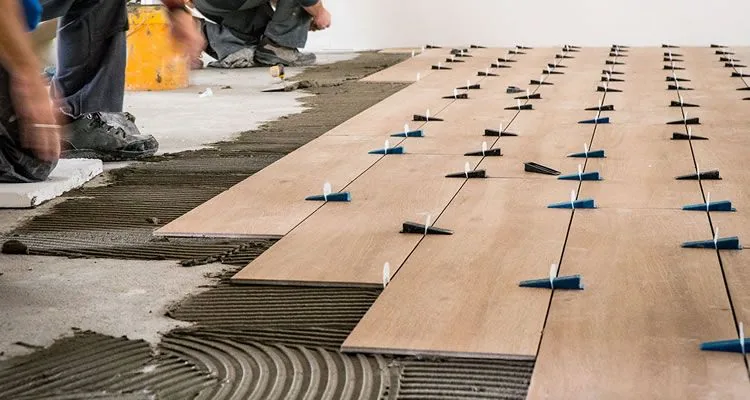
Mortar combed in one direction and back-buttered on large format, tiles beaten in flat and checked for lippage as we go, then grouting, movement joints at the perimeter, and sealing where the product calls for it.

What we test before the mortar comes out

Tile is the least forgiving floor we install. Everything that goes wrong with it was decided before the first tile was set.

Whether the floor moves at all

We walk it, we load it, and we look at the joist bay from below where there is access. A floor that flexes underfoot will crack grout no matter how good the tile or the mortar is, and the honest answer is sometimes to stiffen the structure first.

Whether your tile size matches your substrate

Large format demands a flatter floor than small tile, and the flatness cost lands on your quote as levelling. If you want large tiles over a wavy 1920s deck, that is a legitimate plan with a real preparation number attached, and we would rather show you both than quietly under-prepare.

What the old tile will cost to remove

Ceramic and porcelain removal runs around $4 per square foot in Toronto, against $1 to $3 for carpet, laminate or vinyl. It is dusty, loud and slow, and it often takes the thinset bed and part of the underlayment with it. Removal and replacement together typically lands at $4 to $8 per square foot.

Whether heat is going in now or never

Electric heated floor is straightforward under tile at the build stage and a full teardown afterwards. The heating system alone runs $8 to $15 per square foot, and bundled with the finish floor and the electrical work it runs $22 to $40. If it is a maybe, we tell you now that now is when it is cheap.

Reading a cracked grout line in tile

If the grout in a tile floor has cracked in a line, the tile is reporting on the floor underneath it. Tile and grout are rigid and brittle. They have no capacity to absorb movement, so any flex in the assembly below arrives at the grout joint, which is the weakest and most brittle element in the system.

Deflection is the amount a floor bends between supports under load. It depends on how deep the joists are, how far apart they sit, how far they span, and how thick and stiff the deck on top of them is. Those four things together are what a tile floor is really built on. The Ontario Building Code sets the minimum subfloor thickness against joist spacing in Article 9.23.14.5, and the requirement steps up as the bays widen: a 610 mm bay needs a thicker deck than a 406 mm bay, and oriented strand board needs more thickness than plywood for equivalent performance. Note that the table most contractors quote is the 2012 and 2017 edition, and the legally effective code has been the 2024 edition since the first of January 2025, which is why we work off measurement rather than memory.

We check the assembly before quoting, and in an older Toronto house we look at the joist bay from below where the basement gives us access. The fixes at this stage are cheap: an added plywood layer at $1 to $4 per square foot, or blocking between joists. The fix after the tile is down is the tile coming back up.

Paying for large tile is paying for labour

Tile size is a labour decision as much as a design one, and the Toronto numbers make that obvious. Standard-format labour runs $8 to $15 per square foot. Large format runs $15 to $25. That is not a premium for handling a fashionable product. It buys three specific things.

Flatness first. A small tile spans a short distance, so a gentle undulation in the floor gets absorbed across many joints and nobody notices. A large tile spans that same undulation in one rigid piece, and the result is lippage: one tile edge standing proud of its neighbour. You see it in raking light and you feel it with a bare foot, and it is the most common complaint on a large-format floor. Getting the substrate flat enough is levelling work, at $2 to $4 per square foot over a deck or $3 to $6 over a slab.

Mortar coverage second. A large tile needs close to full support under its whole face, not just under the ridges of a combed bed. That means combing the substrate in one consistent direction and back-buttering the tile as well, on every tile. It roughly doubles the setting work per unit area.

Handling third. Large tiles are heavy and they flex slightly when lifted, so setting them flat is a two-person operation with more checking between tiles. Fewer joints does not mean faster.

None of this argues against large format. It argues for pricing it as what it is, and for deciding on tile size before the substrate budget is fixed rather than after.

Choosing porcelain or ceramic tile for a floor

Both are fired clay. Porcelain is fired denser and harder, and that density is the whole difference.

For a floor, porcelain is usually the right call. It resists chipping from a dropped pan or a dragged chair leg better than standard ceramic. Through-body porcelain carries its colour all the way through the tile rather than only in a glazed surface layer, so when a chip does happen the exposed material matches and the damage nearly disappears. It handles freeze and thaw at a cold entryway better, and it shrugs off the winter salt and grit that comes through a Toronto front door from November to April.

Ceramic holds its place. It is easier and faster to cut, it is lighter to handle, and on a wall or in a low-traffic room the durability gap does not matter much. Where budget is tight and the floor is a powder room rather than a main entry, ceramic is a reasonable purchase and we will say so.

The practical caution is that porcelain’s hardness costs labour. It cuts more slowly, it consumes blades, and fiddly cuts around a toilet flange or a stair nosing take longer. If a tile quote seems high for a small bathroom, the cut count and the material hardness are usually where it went.

Tile installation questions

Why did my last tile floor crack along the grout lines?

Because something under the tile moved and the grout joint was the weakest line available. Tile does not flex. A floor that deflects under load, whether from joists spanning too far, a deck that is thinner than the joist spacing calls for, or a subfloor panel that was never fastened properly, transfers that movement straight into the tile assembly. The crack usually runs in a straight line across the floor, often parallel to the joists or over a seam in the deck, and that pattern is the tell. Re-grouting it puts new grout on a floor that will move again. Fixing it means addressing the deflection first.

What is an uncoupling membrane and do I need one?

It is a layer that sits between the substrate and the tile and allows the two to move independently, so small movement in the deck below is absorbed rather than delivered to the grout. It is not a substitute for a floor that is stiff enough, and no membrane rescues a badly deflecting structure. Where it earns its cost is over a wood deck in an older Toronto house, over a slab that already has hairline cracking in it, and under electric heated floor cable where daily thermal movement is a certainty. We specify it as a line item and explain which of those reasons applies to your floor.

Is porcelain worth more than ceramic?

In most floor applications, yes. Porcelain is fired denser and harder than standard ceramic, which makes it more resistant to chipping and better suited to a floor rather than a wall. Colour in a through-body porcelain runs through the tile instead of sitting only on a glazed surface, so a chip on a porcelain floor is far less visible than the same chip on a ceramic one. Porcelain also cuts harder and slower, which shows up in labour. For a Toronto entryway, kitchen or anywhere that meets winter boots and road salt, porcelain is the one we recommend.

Why does taking out old tile cost more than taking out carpet?

Because it has to be broken rather than lifted. Carpet, laminate and vinyl removal runs $1 to $3 per square foot in Toronto, and it is mostly cutting, rolling and carrying. Old ceramic or porcelain sits at around $4 per square foot, because every tile is bonded to a mortar bed that also has to come off, and often that bed is bonded to a cement board or plywood underlayment that comes up with it. Add dust containment, heavier debris weight, and the chance of finding damaged subfloor underneath. Removal and replacement together typically lands at $4 to $8 per square foot.

Does large-format tile really cost more to install?

Yes, and the difference is significant. Toronto labour for large format runs $15 to $25 per square foot against $8 to $15 for standard sizes. Three things drive it. The substrate has to be flatter, because a dip that a small tile absorbs shows as a raised edge, or lippage, on a big one, and you feel it underfoot. Mortar coverage has to be near complete, which usually means back-buttering every tile as well as combing the floor. And the tiles themselves are heavy and awkward, so setting them flat takes two people and more time per square foot, not less.

Have the structure checked before you buy tile

Joists, deck, flatness and format. We measure all four, then quote removal, substrate and setting as separate lines so you can see where the money goes.

Back to top