Written quote within one business day, across Toronto and the GTA
$3.50-$9 per sq ft Sand plus three coats Wear layer checked first Toronto and the GTA

Hardwood floor refinishing in Toronto

Toronto Flooring Co sands and refinishes solid and engineered hardwood across Toronto and the GTA, and we measure how much wood is left above the tongue before we sell you a sanding.

Wear layer read at a floor vent or a doorway
One sealer coat and two topcoats as the standard build
Dustless containment priced as a line item, not assumed
Damaged boards replaced inside the refinish, not after it

Book a refinishing measure

Rooms, rough square footage, and roughly when the floor was last done. That is enough to start.

What can we help with?

So the right crew reviews your project.

Any workmanship warranty is set out in your written quote, job by job.

Sanding and finishing

How much wood does refinishing actually remove?

A full refinish removes finish plus a thin layer of wood, and that layer is finite. On solid hardwood the usable wood is everything above the tongue, so a floor that has already been sanded twice has less left than a floor that has never been touched. On engineered hardwood the usable wood is the veneer on top of the plywood core, which is why wear layer thickness decides whether an engineered floor can be refinished at all. We find a vent cutout, a return air grille or a doorway saddle, lift it, and look at the board in section. That reading costs nothing and it settles the argument before anybody books a machine. If there is not enough wood, we say so and price a replacement instead of taking your money for a sanding that will cut through to the tongue.
What a refinish includes

Wear layer read in section

We open a vent or a threshold and look at the edge of a board rather than guessing from the surface. Solid gets measured above the tongue, engineered gets measured at the veneer. That one reading decides refinish or replace.

Three coats, built in order

One sealer coat and two topcoats is the Toronto standard, and it is what we quote unless you ask otherwise. The sealer controls how the stain sits and how the topcoats bond. Skipping it saves a few dollars a square foot and costs you the finish.

Dust containment priced honestly

Dustless sanding runs a premium of roughly twenty-five to forty percent on the sanding portion, according to the Toronto sources we track. It is a real reduction, not a claim of zero dust. We quote it as an option so you can decide what it is worth in your house.

Refinishing prices in Toronto

Toronto and GTA ranges collected September 2026. Refinishing prices scale inversely with area: the smaller the job, the higher the per square foot rate, because setup, edging and machine mobilisation cost the same in a bedroom as in a whole floor.

By floor area

$5-$12 / sq ft

  • About 150 sq ft: $8 to $12 per sq ft
  • About 250 sq ft: $6 to $8 per sq ft
  • About 600 sq ft: $5.50 to $6.50 per sq ft
  • About 1,000 sq ft: $5 to $6 per sq ft
Ask where yours lands

Whole-project totals

$1,500-$12,000

  • Condo, 500 to 700 sq ft: $1,500 to $4,200
  • Townhouse, 600 to 900 sq ft: $1,800 to $5,400
  • Detached, 1,200 to 2,000 sq ft: $3,600 to $12,000
  • Board replacement inside a refinish $8 to $15 per sq ft
Get a written scope
Our Process

How a refinish runs

1

Read the floor

Wear layer at a vent or doorway, board type, existing finish, cupping and gaps, and which boards are past saving. Then a written quote split into sanding, stain, coats and board work.

2

Clear and contain

Furniture moved, at $25 to $75 per room if you want us to do it, doorways sealed, and vents taped so the dust does not travel through the return air ducts into the rest of the house.

3

Sand and repair

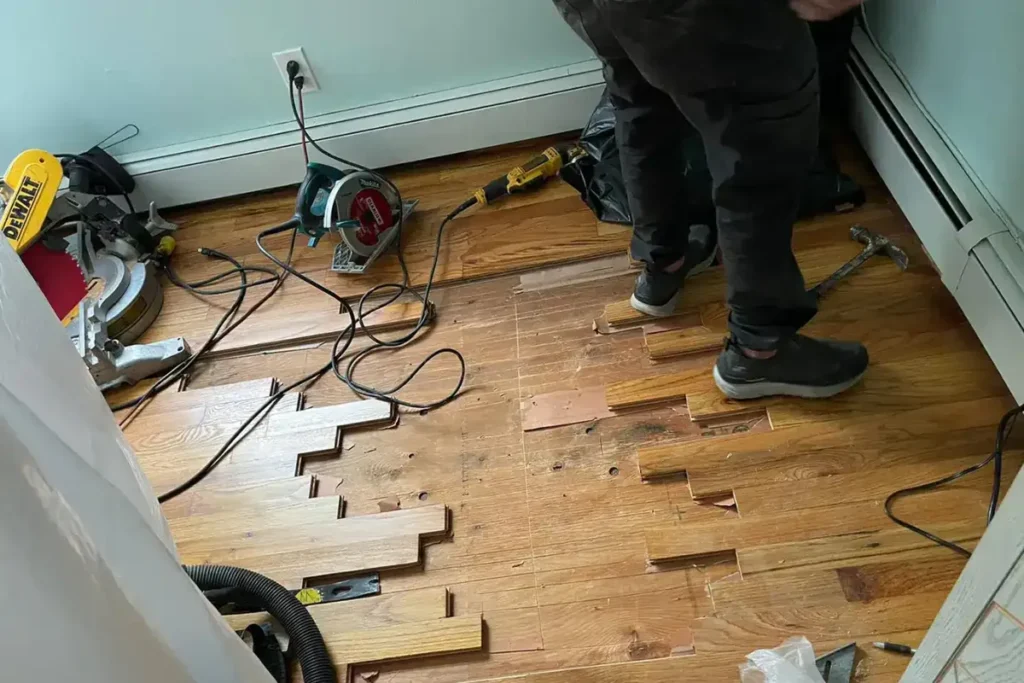
Coarse to fine passes with the big machine, edger into the perimeter, corners by hand, and any replacement boards woven in and sanded flat with the rest before a drop of finish goes on.

4

Seal, coat, cure

Stain if you chose one, then sealer, then two topcoats with a light abrasion between coats. Cure time comes from the manufacturer of the product we used, and it goes on your paperwork.

What we say before we book a sanding date

Refinishing is the one flooring job that can be sold to someone who does not need it. These are the conversations we have first.

Whether there is enough wood left

If the wear layer is thin, sanding gets you one short-lived floor and no future options. We would rather lose the sanding and quote the replacement than cut through your tongue and hand you the bill.

That the small room is the expensive one

A 150 square foot bedroom can land at $8 to $12 per square foot while a 1,000 square foot main floor lands at $5 to $6. Nothing is being marked up. Setup, edging and hand work do not shrink with the room.

That gaps may not close

Wood floors want thirty to fifty percent relative humidity according to the National Wood Flooring Association. Gaps that open every February on an unhumidified floor are a humidity problem, and filling them in March traps the filler when the boards swell in August.

What we will find under the old finish

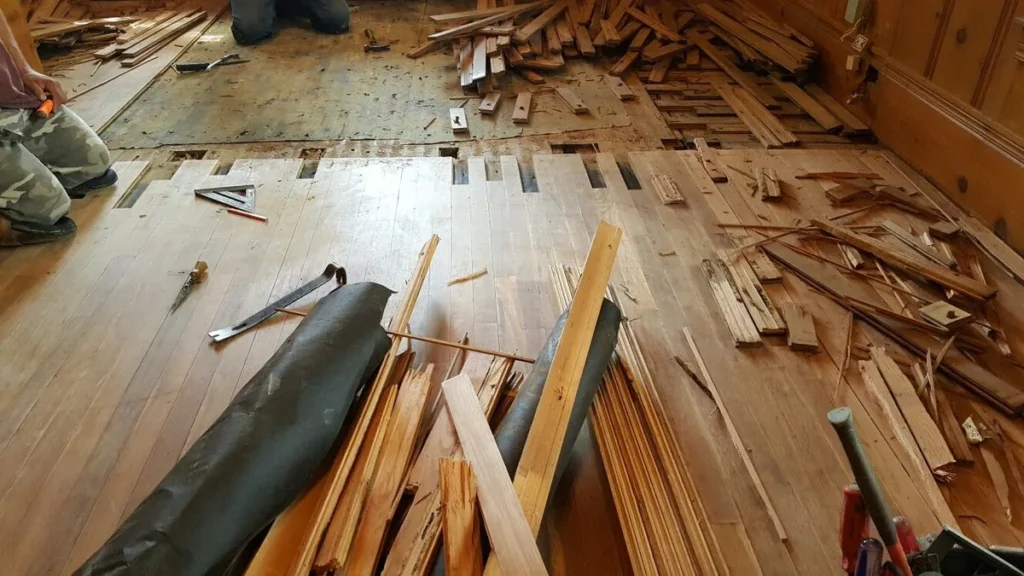
Pet stains that reached the wood, water damage at a radiator, and old adhesive from a carpet job all appear at the first sanding pass. We photograph them, stop, and price the fix before we keep going.

Is there enough hardwood left to sand?

Everything about refinishing starts with one measurement: how much wood sits above the tongue. That is the only part a sanding machine can remove without destroying the floor, and it is a fixed budget spent across the life of the floor. A floor sanded in 1985 and again in 2004 has already spent most of it.

The reading takes a minute and needs no tools beyond a screwdriver. Pull a floor vent cover and you are looking at the cut edge of real boards. Lift the saddle in a doorway and you get the same view. On engineered hardwood the picture is even clearer, because the veneer sits as a visible band on top of the plywood core and you can see how thick it is. A generous veneer means the floor can be sanded like solid wood. A thin one means a screen and recoat or nothing.

We do this before quoting because the honest answers are unevenly profitable. Telling you the floor has plenty of wood sells a refinish. Telling you it does not sells nothing at all until you are ready to replace. The reading decides it, not the sales conversation.

How does room size change a refinishing price?

Refinishing prices run backwards from what people expect. The per square foot rate goes up as the job gets smaller, and the curve is steep. Around 150 square feet, Toronto rates land at $8 to $12 per square foot. At 250 square feet it drops to $6 to $8. By 600 square feet it is $5.50 to $6.50, and at 1,000 square feet it settles at $5 to $6.

The reason is that most of the cost is not the open floor. It is setup, containment, moving the drum sander in and out, edging the perimeter, hand work in the corners, and coming back for each coat. Those costs barely change between a bedroom and a whole storey. Spread across 150 square feet they dominate the number. Spread across 1,000 they disappear into it.

Two things follow. If you are refinishing one room now and two more next year, you will pay more in total than doing all three at once. And if a small-room quote looks high next to a per square foot figure you saw online, check what area that figure was quoted at before assuming you are being overcharged.

Do you need refinishing or just a recoat?

A screen and recoat leaves the wood alone. A buffer with an abrasive screen scuffs the existing finish so a new topcoat can bond, then one coat goes down. It restores sheen, hides light scuffing, and buys the floor more years before a real sanding. It does not remove stains, it does not level cupping, and it will not touch a scratch that went through the finish into the wood. If any grey or black patches exist, the finish there has already failed and a recoat seals the damage in.

We are deliberately not printing a per square foot price for it. The Toronto sources we track disagree by about three times on what it should cost, which is a wide enough spread that any single number we published would be misleading for half of you. What we will do is look at your floor, tell you whether a recoat is even appropriate, and quote it against the specific product and area.

The other thing worth knowing: not every finish accepts a recoat. Some factory finishes and some older products need a full abrasion or a chemical bonding step before anything will stick, and a recoat over a finish that rejects it peels in sheets within a year. We test a small area in a closet first.

Refinishing questions

How do I tell if my floor has enough wood left to sand?

Look at a board in section rather than from above. Lift a floor vent cover, pull a threshold saddle, or check where the floor stops at a stair nosing, and you can see the board edge. On solid hardwood, the wood above the tongue is the part a sander can use, and once that is gone the floor is done. On engineered, the veneer above the plywood core is the whole budget, and a thin veneer means one careful sanding or none. We do this check on the first visit at no charge because it is the question that decides the entire job.

What does three coats mean, and why not two?

Three coats in Toronto means one sealer coat and two topcoats, and that is the build our prices assume. The sealer does a different job from the topcoats: it controls how evenly stain and finish sit on the grain and it gives the topcoats something consistent to bond to. Two topcoats over bare wood is a thinner system that wears through in traffic lanes first. If a quote is materially cheaper than the $3.50 to $9 per square foot range, ask how many coats and which ones.

Is dustless sanding worth the premium?

It costs more and it is not zero dust. Toronto sources put the premium at roughly twenty-five to forty percent on the sanding portion, which is real money on a 1,000 square foot floor. What you get is vacuum extraction at the machine and containment at the doorways, so far less airborne dust settles into the rest of the house. In an occupied home with people staying through the work, or anywhere with forced air running, we usually recommend it. In an empty unit before move-in, the cheaper option is defensible.

Can you stain my floor a different colour?

Yes, and it adds roughly $0.75 to $1.50 per square foot on top of the sanding and coating. The limit is the species, not the stain. Red oak takes colour evenly and predictably, which is part of why it is the Toronto default. Maple is harder and blotches under dark stain unless it is conditioned first, and that extra step belongs on the quote. We put sample patches on your own floor in your own light before you commit, because a stain chip under a shop light tells you very little.

Is a screen and recoat the same as refinishing?

No, and the price gap makes that obvious. A screen and recoat abrades the existing finish and adds a fresh topcoat without touching the wood, so it fixes dullness and light scuffing and does nothing for stains, deep scratches or grey patches where the finish has already failed. Be careful with pricing here: the Toronto sources we track disagree with each other by roughly three times on what a screen and recoat costs per square foot. Because of that spread we will not print a single number for it, and we quote your specific floor after looking at it.

Find out if your floor can be saved

We read the wear layer at a vent or a doorway, tell you refinish or replace, and put the answer in writing either way.

Back to top