Written quote within one business day, across Toronto and the GTA
$5-$14 per sq ft Slab tested before coating 10-15% off November to March Garage, basement, workshop

Epoxy flooring in Toronto

The coating is the easy part of an epoxy floor and the slab underneath is the whole job, which is why Toronto Flooring Co quotes the grinding and the repairs before it quotes the colour.

Diamond grinding rather than acid etching
In-situ slab humidity tested against the coating limit
Oil contamination and crack repair priced as their own lines
Solid, flake, metallic and polyaspartic systems explained

Price an epoxy floor

Garage or basement, rough dimensions, the age of the slab and whether there are oil stains or cracks.

What can we help with?

So the right crew reviews your project.

Any workmanship warranty is set out in your written quote, job by job.

Preparation

Grinding the slab before any epoxy goes down

An epoxy floor fails at the bond line or it does not fail at all. Everything that decides which way it goes happens before the first coat: the slab gets mechanically ground with diamond tooling to open the concrete and take off the laitance layer, the surface gets vacuumed rather than swept, contamination gets removed instead of coated over, and the moisture gets measured. Coatings want an in-situ relative humidity reading under seventy five percent, or under three pounds per thousand square feet per day on the calcium chloride test. A slab that reads above that will push vapour up through a cured coating and lift it in sheets, and no amount of primer argues with it. This is why a two hundred dollar kit from a big box store peels off a Toronto garage in a season and a properly ground and tested floor does not. The materials in both buckets are broadly similar. The preparation is not.
What decides whether a coating sticks

The moisture number

Coatings need the slab under seventy five percent in-situ relative humidity, tested with a probe drilled to forty percent of slab thickness and left at least twenty four hours. Below grade and slab on grade floors are exactly where that reading tends to be high.

What is in the concrete already

Oil, transmission fluid, road salt and old sealers all live inside the top of a garage slab rather than on it. Degreasing and grinding remove what can be removed, and where a stain has gone deep we tell you it will be a shadow rather than promising it disappears.

Mechanical profile

Diamond grinding gives the coating a texture to key into. Acid etching is the shortcut and it is the reason most failed garage floors failed. Grinding also flattens the trowel ridges and old patching that would otherwise telegraph through a high gloss finish.

Epoxy flooring pricing in Toronto

Toronto and GTA rates collected September 2026, supplied and installed. Four systems, four prices, and the difference between them is real rather than a sales ladder. Preparation and repair are quoted on top.

Solid colour epoxy

$5-$8 / sq ft

  • Single colour, no broadcast
  • The economical garage and basement option
  • Grinding and priming included
  • Shows tyre marks and repairs more than flake does
Price solid colour

Polyaspartic and commercial

$7-$15 / sq ft

  • Polyaspartic $7-$14 per sq ft
  • Commercial grade $10-$15 per sq ft
  • Faster return to service and better UV stability
  • Used as a topcoat over epoxy as well as on its own
Price polyaspartic
Our Process

How an epoxy floor gets installed

1

Test and inspect

In-situ humidity probes in the slab, a look for oil contamination, cracks, spalling and any previous coating, and a note of where water enters the space.

2

Grind and repair

Diamond grinding across the whole slab, cracks routed and filled, spalled edges rebuilt, joints treated, then vacuumed to a dust free surface.

3

Prime and build

Primer suited to the tested moisture reading, then the base coat, then the flake broadcast or metallic pour if that is the system you chose.

4

Topcoat and cure

Clear topcoat applied, cure time observed to the manufacturer's numbers rather than to the dry-to-touch feel, then a walk of the floor with you before anything is driven onto it.

Surcharges we name before we start

Every one of these is a real cost on a real Toronto slab, and every one of them is cheaper to hear at the quote stage.

A slab that reads too wet

Coatings want under seventy five percent in-situ relative humidity, or under three pounds per thousand square feet per day by calcium chloride. If your slab reads above that, the honest options are a moisture tolerant primer system, which costs more, or not coating it at all. We will tell you the number and let you decide rather than coating it and hoping.

Oil and contamination in the concrete

A garage slab that has had a car parked on it for twenty years has absorbed oil into the top layer. Degreasing and grinding take out what can be taken out, and the rest is priced as remediation depth by depth. Where a deep stain will still read as a shadow under a light solid colour, we say so before you choose the colour.

Cracks, joints and spalling

Cracks get routed out and filled rather than coated across, control joints get treated to their own detail, and spalled edges at the garage door get rebuilt. These are per job numbers because the quantity varies enormously between a 1990s Vaughan slab and a 1950s Bramalea one. They appear as their own lines on the quote.

Old coatings that have to come off

A previous sealer or a failed kit coating has to be ground off completely before anything new goes on, and that is grinding time rather than a fixed rate. Bringing us a photo of the existing floor before the site visit usually tells us most of what we need to know.

Spending most of an epoxy budget on concrete

Take the cost of an epoxy floor apart and the coating is a modest share of it. The rest is labour and machine time on the concrete underneath.

Diamond grinding comes first. The top surface of a power-trowelled slab is a dense, closed layer that a coating cannot key into, and grinding removes it and leaves an open profile. Acid etching is the alternative that gets sold as equivalent, and it is the single most common reason a garage floor is peeling in its second winter.

Then contamination. Concrete is porous, so twenty years of oil drips, brake fluid and winter road salt are inside the top of the slab rather than sitting on it. Degreasing and grinding remove most of it. A deep stain can still read as a shadow under a pale solid colour, which is worth knowing before the colour gets chosen rather than after.

Then the defects. Cracks get routed out to a clean V and filled, control joints get their own detail so the floor can still move, and spalled concrete at the garage door threshold gets rebuilt before anything is coated over it. These carry real surcharges and we itemise them, because the quantity is entirely dependent on your slab and no honest fixed rate exists for them.

Then the moisture test. Coatings want the slab under seventy five percent in-situ relative humidity, or under three pounds per thousand square feet per day on the calcium chloride method. The probe goes in at forty percent of slab thickness for a slab drying from one side and sits for at least twenty four hours. On a below grade basement slab, or a garage slab on wet ground, that reading is the thing most likely to change the specification.

Starting at solid colour epoxy and moving up

Solid colour epoxy runs $5 to $8 per square foot supplied and installed. It is one colour, no broadcast, and it does the job in a basement or a tidy garage. It also shows tyre marks and any patch repairs more readily than the textured systems do.

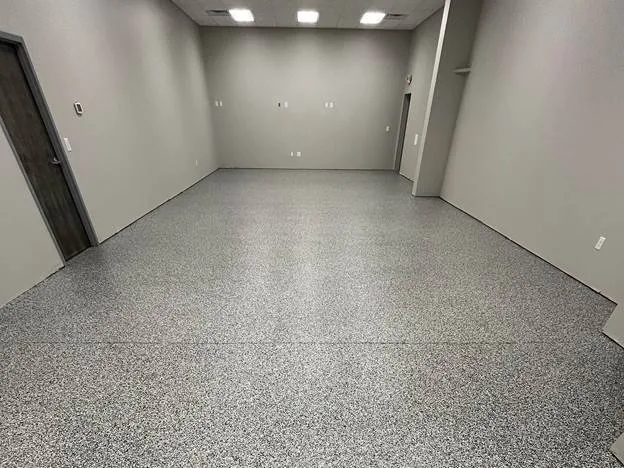
Flake broadcast runs $6 to $10. Vinyl chips are thrown into the wet base coat and locked under a clear topcoat. The flake does three useful things at once: it disguises slab imperfection, it adds grip underfoot on a floor that will get wet with snowmelt, and it hides the dirt that a solid colour advertises. In a Toronto garage it is the system that gets chosen most.

Metallic runs $8 to $12. Pigment is worked into the coat to give a poured, marbled appearance. It is a decorative finish and it belongs in a finished basement, a showroom or a home gym rather than under a car.

Polyaspartic runs $7 to $14. It cures faster, which shortens the time before you can walk and drive on the floor, and it holds colour better under UV. It is frequently used as the topcoat over an epoxy base rather than as the whole system.

Commercial grade runs $10 to $15. That is a higher build, a tougher chemistry and a specification written for forklifts, plant rooms and trade counters rather than for a car and a lawnmower.

Booking epoxy between November and March

Most seasonal urgency in this trade is invented. This one is not.

Epoxy contractors in the GTA discount by ten to fifteen percent from November through March. The reason is simple scheduling: outdoor and exterior-adjacent work dries up, and crews would rather run at a lower rate than sit idle. That is a genuine supply condition rather than a countdown timer.

The work itself does not care about the month. An epoxy floor is installed in a garage or a basement, both of which are enclosed. What matters is the temperature and humidity of that space during application and cure, which is a matter of whether the garage is heated, not whether it is February. Where a garage is unheated we bring the space up and hold it, and that is a line on the quote rather than a reason to refuse the job.

So if your floor is not urgent, book it in the winter. It is the one piece of timing advice on this website that puts money back in your pocket without changing the specification, and the reason we can say it plainly is that two independent observations of this market point the same way: spring installations run high, and epoxy runs cheap between November and March.

Epoxy flooring questions

Why does epoxy peel off a garage floor?

Two causes account for nearly all of it, and neither is the epoxy. The first is preparation: a slab that was acid etched or just cleaned rather than diamond ground has no mechanical profile for the coating to key into, so the bond is only as strong as the weak surface layer it is sitting on. The second is moisture: a slab reading above seventy five percent in-situ relative humidity pushes vapour upward and lifts a cured coating off in sheets. Both are measurable before the job starts, which is why we grind and test rather than sell you a warranty against it.

Is polyaspartic worth the extra over epoxy?

Often, and for reasons other than toughness. Polyaspartic runs $7 to $14 per square foot against $5 to $8 for solid colour epoxy, and what you get for the difference is a faster return to service and better stability under UV light, which matters on a garage floor that catches sun through an open door. Many systems use both: an epoxy base for build and bond, with a polyaspartic topcoat for wear and colour stability. If a quote says polyaspartic, ask whether that is the whole system or the topcoat, because the two mean different things.

What does an epoxy garage floor cost in Toronto?

Two Toronto epoxy contractors publish totals by garage size and they broadly agree. For a single car garage of 200 to 250 square feet, $1,400 to $2,500 for a standard system and $2,000 to $3,000 for a premium one, with a second source giving $1,800 to $2,800 on 200 to 280 square feet. For a double of 380 to 500 square feet, $2,660 to $5,000 standard and $3,800 to $6,800 premium, with the second source giving $2,800 to $5,200 standard and $4,500 to $7,500 for a polyaspartic one-day system. For a triple of 600 to 750 square feet, $4,200 to $7,500 standard and $6,000 to $9,000 or more premium. A 500 square foot basement runs $3,500 to $5,500 on a clean slab and $5,500 to $9,000 where moisture remediation is needed. Crack repair, degreasing and old coating removal sit on top and get their own lines.

Do larger floors get a better rate?

Yes, and the break usually shows up once the area gets past about two thousand square feet. Mobilisation, grinder setup and the trip charge are the same whether the floor is a garage or a workshop, so spreading them over more square feet pulls the effective rate toward the bottom of the band. We are not going to print a discount percentage we cannot source, so what we do instead is quote your actual area and show the rate we arrived at. If you are coating a large shop, ask for the rate at your full square footage rather than accepting a small-job number.

Why would I book an epoxy floor in January?

Because it is the cheaper window and the work is indoors anyway. Epoxy contractors in this market discount by ten to fifteen percent from November through March, since the season is quiet and crews want the schedule filled. A heated garage or a basement is a controlled environment regardless of what the weather is doing outside, so the constraint is the space rather than the calendar. If your project is not urgent, the winter booking is the one that saves money, and it is one of the few genuine seasonal savings in this trade rather than a manufactured deadline.

Get the slab looked at before the colour is chosen

Send dimensions and a photo of the floor as it is now. We will come back with the system options, the preparation needed, and what each one costs.

Back to top