Written quote within one business day, across Toronto and the GTA
A former summer resort Cottage conversions Two heritage districts Structure checked first

Flooring installation in The Beaches

The Beaches started as a summer resort rather than a subdivision, so Toronto Flooring Co checks the floor structure here before it talks about a finish.

Joist depth and span measured in converted cottages
Deflection checked before solid hardwood is recommended
Heritage by-law read for your address, in writing
Queen Street East shop floors quoted as commercial work

Book a measure in The Beaches

Your street, whether the house started as a cottage, and the rooms you want done.

What can we help with?

So the right crew reviews your project.

Any workmanship warranty is set out in your written quote, job by job.

The Beaches housing

The Beaches began as a summer resort

This was not laid out as a suburb. The area began as a heavily wooded stretch dotted with private homes and swampland, used as a summer resort. The Toronto Harbour Commission appropriated the shoreline and the Kew Gardens grounds in the early 1900s, the artificial beach was made continuous in 1930 using wooden groynes, and the public boardwalk opened in 1932. The housing that grew out of that is a mix: semi-detached and large-scale Victorian, Edwardian and newer houses, alongside low-rise apartments and a few row houses, with residents pursuing heritage designations specifically to preserve the traditional cottage-like appearance. What sits underneath those floors varies far more here than in a planned neighbourhood, because a building put up for six weeks of summer was not framed for a year-round hardwood floor. So we measure the structure before we discuss the finish.
What we measure in a Beaches house

Joist depth, span and spacing

A floor framed for seasonal use may be shallower and more widely spaced than a year-round house of the same age. Those three numbers together decide whether the floor is stiff enough for solid hardwood or whether strengthening comes first.

How much the floor moves underfoot

Deflection is what makes a fastener work loose and a joint open. We check it before recommending nail-down, because a floor that flexes will telegraph that into any hard surface you put on it, including tile.

What the deck reading allows

Where the structure is sound but the deck is thin, an added layer brings it up to the thickness your joist spacing needs. Where it is not, we say so and price the structural work separately instead of nailing into optimism.

Where we work

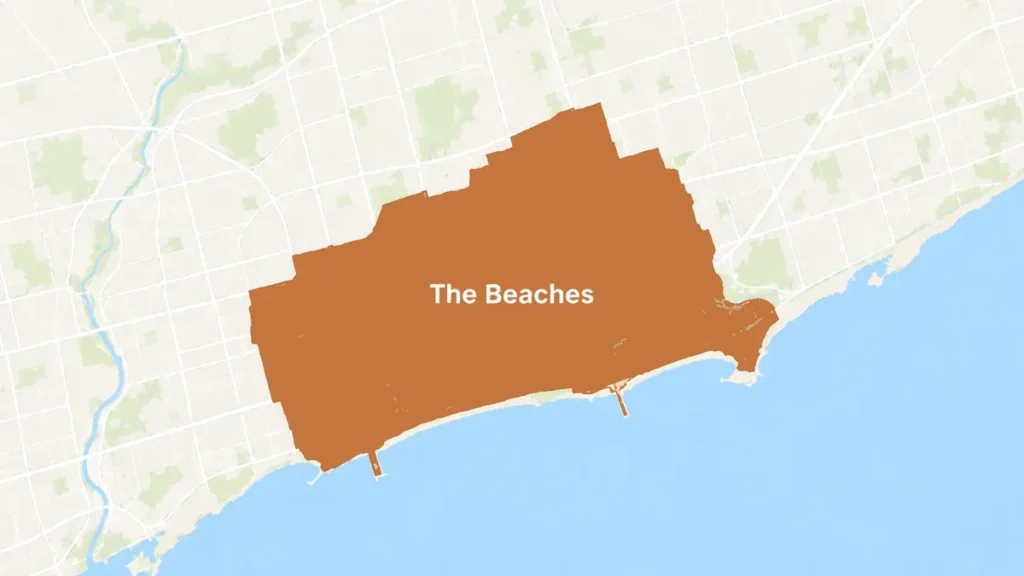
Where do The Beaches begin and end?

The Beaches runs from Victoria Park Avenue in the east to Kingston Road in the north, along Dundas Street across to Coxwell Avenue in the west, and south to Lake Ontario. The lakefront is four beaches in a row: Balmy, Scarboro, Kew and Woodbine. Queen Street East is the commercial spine and is characterised by a large number of independent speciality stores, which is why a fair share of our work here is shop floors rather than living rooms. The housing sits between the two: streets where a converted summer cottage and a full Edwardian house stand side by side, built decades apart for entirely different purposes. We quote by address, not by street, because on most streets here the street is not a useful unit.

Our Process

How a Beaches job is ordered

1

Read the building

Original cottage, later conversion, purpose-built Edwardian or a Queen Street storefront. That answer decides whether the first measurement is structural or cosmetic.

2

Check the structure

Joist depth, span, spacing and deflection, plus the deck thickness over them. If strengthening is needed it gets priced now, with its own line and its own timeline.

3

Confirm the paperwork

We read your designation by-law where you are in a heritage district, and confirm in writing whether anything about your interior is covered before you order material.

4

Install and review

Prep completed, floor laid to the manufacturer's flatness tolerance, trim fitted, then walked with you against the written scope.

What a cottage conversion changes

Three honest answers we give before a Beaches job starts.

Solid hardwood is not automatic here

Solid hardwood is fastened down and depends entirely on the structure beneath it. Where a converted cottage has a shallow floor frame, engineered flooring over a corrected deck is often the better product, and we will say so even though it is not the larger sale.

We will not tell you what is under there from the doorway

Two houses on one Beaches street can be forty years apart in age and built for different seasons of the year. We open a vent or a closet corner and read the deck rather than pattern matching from the outside.

Strengthening is a separate job with a separate price

If the structure needs work, that is framing rather than flooring and it changes the schedule. It also changes the permit conversation, because the City's exemptions turn on whether work involves structural or material alterations. We raise it at the survey, not after demolition.

Joists under a Beaches cottage conversion

Structure comes before product in The Beaches because The Beaches has a building type most Toronto neighbourhoods do not: a summer cottage that became a permanent home. The area began as a wooded stretch of private homes and swampland used as a resort, and the permanent neighbourhood grew around and on top of that.

A floor frame built for seasonal use can be shallower, more widely spaced or both. That does not make it unsafe. It makes it springy, and springiness is the enemy of every hard surface. A floor that deflects under load works fasteners loose, opens joints in hardwood and cracks grout in tile. The check takes minutes: depth and span of the joists, spacing between them, deck thickness over them, and how much the floor moves when someone walks it. Four readings, and they decide whether the conversation is about oak or about framing.

Two heritage districts inside The Beaches

The Beaches contains two of Toronto’s twenty-seven Heritage Conservation Districts: Lyall Avenue, designated in 2006, and Kingswood Road South, designated in 2010. Owners on and near those streets reasonably want to know what that means for a renovation.

The City of Toronto’s published position is that changes to the interior, changes to the exterior that are not visible from the street, and routine maintenance like painting do not require a heritage permit. The exception applies where a property’s own designation by-law specifically describes interior heritage attributes, and an application then has to include them. That is the check we run for your address before quoting, and we give you the answer in writing so you are not relying on what a neighbour heard. A district designation is about how the street looks. Your floor is not part of that.

The Beaches flooring questions

My house was a summer cottage. Can it take solid hardwood?

Often yes, sometimes only after the floor frame is brought up to standard. A building put up for a summer season in a wooded lakeside area was not framed to the same brief as a year-round house, and the floor structure is the part that shows it. We measure joist depth, span and spacing, check how much the floor moves underfoot and read the deck thickness over the joists. If all four are sound, solid hardwood is straightforward. If the frame is shallow, the honest options are strengthening it first as its own priced job, or choosing engineered flooring over a corrected deck, which does not rely on the same fastening.

How do you tell a converted cottage from a built house?

By what we find, not by the facade. The Beaches holds semi-detached and large-scale Victorian, Edwardian and newer houses on the same streets, and residents have pursued heritage designations specifically to preserve the traditional cottage-like appearance, which means exteriors are a poor guide to what is inside. The reliable tells are structural: joist sizing that does not match the apparent age, framing that changes partway through the house, floor levels that step where an addition was added, and deck material that switches from boards to panels in the middle of a room. We record all of it on the survey sheet.

Do you do shop floors on Queen Street East?

Yes, and we quote them as commercial work rather than as a large house. Queen Street East is the commercial spine of The Beaches and is characterised by independent speciality stores, most of them in older buildings with residential floors above. That changes three things: the wear rating the floor has to carry, the hours we can work without shutting your trade down, and the noise reaching the units above. Commercial flooring in Toronto is quoted around six to twelve dollars per square foot and up, from a single source, so treat that as a starting range and let us put a real number against your space.

Book a measure in The Beaches

Structure first, finish second, and a written answer on your heritage by-law before you order anything.

Back to top