Written quote within one business day, across Toronto and the GTA
Refinish $3.50-$9 per sq ft Heritage streets checked, not assumed Unionville, Cornell, Milliken, Thornhill Free measure

Flooring installation in Markham

Markham is a post-1970s city with two designated heritage main streets inside it, so Toronto Flooring Co asks which one you live near before saying whether your floor is a refinishing job or a replacement.

Existing floor assessed for refinishing before replacement is quoted
Designation by-law checked on heritage-street addresses
Panel deck and joist spacing measured on newer builds
Levelling priced openly, not discovered later

Get a Markham quote

Community, rough square footage and roughly when the house was built. That is enough to start.

What can we help with?

So the right crew reviews your project.

Any workmanship warranty is set out in your written quote, job by job.

Two eras

Farmland became subdivisions across most of Markham

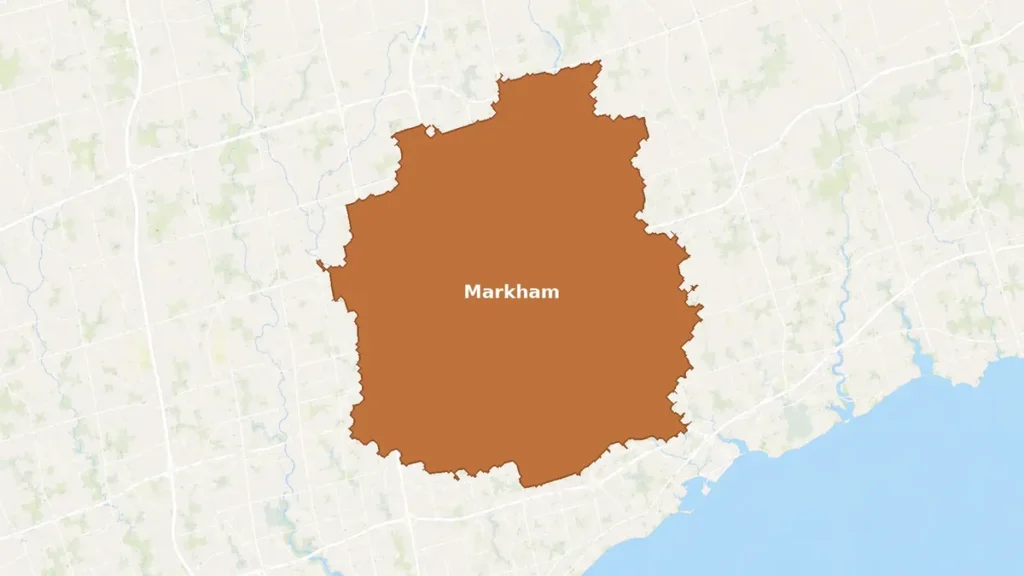
Markham shifted from an agricultural community to a built-up municipality from the 1970s onward, and the population was around 56,000 as recently as 1976 against 338,503 in 2021. Almost everything you can see was built after that shift. The exception sits in plain view: Main Street Unionville and Main Street Markham are designated heritage streets, a nineteenth-century layer inside an otherwise post-1970s city. Those two kinds of building do not take the same floor. Older stock brings board decking, uneven bearing and flatness that has drifted over a century, which is a levelling and refastening conversation. Newer stock brings panel decking and engineered framing, which is a thickness and flatness conversation. We ask the age of the house before we ask anything about product.
What a Markham survey covers

The by-law, not the assumption

Markham is its own municipality with its own heritage rules, so on a designated street we check the property's designation by-law rather than telling you what Toronto's rules say. Interior heritage attributes only bind where the by-law describes them.

Refinish assessed before replace

If the existing floor has enough thickness left, sanding and three coats runs $3.50 to $9 per square foot and beats replacement on price every time. We check wear layer and board condition before quoting a new floor over a floor that did not need to go.

Flatness read in both eras

A century-old floor has usually moved and a new one was not necessarily laid flat. Either way we take the readings over six feet and ten feet, because glue-down and nail-down have different tolerances and the readings decide which is available.

Where we work

Markham is made of six principal communities

Markham has six principal communities: Berczy Village, Cornell, Markham Village, Milliken, Thornhill and Unionville. Unionville itself divides into Original Unionville, South Unionville which has been developed since the 1990s, and Upper Unionville, which is three construction eras under one place name. European settlement here goes back to 1794, when William Berczy led German families into the area, and the municipality only changed its designation from town to city on 1 July 2012 after a council vote that May. Today it is the sixteenth largest municipality in Canada and fourth in the GTA. We work across all six communities, and the first question on the phone is not which one you live in but roughly when your house was built, because that is what changes the survey.

Our Process

Markham, start to walkthrough

1

Date the building

Roughly when it went up, and whether the address sits on a designated street. That sets which survey we run when we arrive.

2

Assess what is already there

On an older floor we check whether there is enough left to sand rather than assuming replacement. On a newer one we measure the deck and the spacing.

3

Price prep separately

Levelling, refastening and deck reinforcement quoted on their own lines at $1 to $4 per square foot for subfloor work and $2 to $4 for levelling.

4

Do the work and hand it over

Install or refinish, fit transitions and trim, then walk the floor with you before we clear the site.

What we will not assume about your Markham address

Four assumptions other quotes make that we go and check instead.

That a heritage street means you cannot touch the floors

Heritage designation ordinarily controls what is visible, and interior work is only caught where a property's own designation by-law describes interior attributes. We read your by-law before we tell you anything either way, because guessing in either direction costs you.

That a Unionville address means an old house

South Unionville has been developed since the 1990s and Upper Unionville later again. The place name tells us where to drive, not what we will find when we lift a corner of the carpet.

That the old floor has to come out

Sanding and three coats is one sealer and two topcoats, and on 600 square feet it lands around $5.50 to $6.50 per square foot against a replacement cost several times that. We will quote the cheaper option when the floor supports it.

That a new build is a simple install

New construction still has to be measured. Panel thickness, joist spacing and flatness all vary, and if the deck is under the manufacturer's minimum for your spacing, nail-down is the wrong call no matter how new the house is.

Why 1976 still shows up in Markham quotes

Markham had a population of roughly 56,000 in 1976. It has more than quintupled since, reaching 338,503 in 2021. That single comparison tells you what you need to know before quoting a floor here: the overwhelming majority of Markham housing was built after the mid-1970s, during the sprawl that followed from neighbouring Toronto, and it carries the construction methods of that period rather than of the century before it.

A post-1970s house means panel decking, engineered framing and a deck whose thickness we measure rather than assume. It means the failure modes are panel edges and thin sheets, not loose planks. And it means that when a homeowner tells us the floor squeaks, the likely cause is different from the likely cause in an older part of the region.

In Markham, Unionville covers three build dates

Place names in Markham hide two or three construction eras each. Unionville splits into Original Unionville, South Unionville which has been developed since the 1990s, and Upper Unionville. Main Street Unionville and Main Street Markham are designated heritage streets, a nineteenth-century layer sitting inside a city that otherwise dates from the 1970s onward.

Those old buildings are a genuinely different job. Board decking rather than panels. Bearing that has moved over a hundred years, so the flatness reading matters more. Loose boards that need refastening to the joists before anything new goes over them, and a look in the joist bays before the floor closes.

They are also the jobs where refinishing deserves a proper look before replacement gets quoted. Sanding and three coats is the standard Toronto specification, one sealer and two topcoats, and it costs a fraction of a new floor when there is enough wood left to work with. We check that first. On the heritage streets we also read the property’s designation by-law rather than telling you what another municipality’s rules say, because interior work is only caught where the by-law describes interior attributes, and Markham writes its own.

Markham flooring questions

Do I need a heritage permit to change the floors on a designated Markham street?

Check the property's own designation by-law, and we will do that with you rather than answering from another city's rules. Heritage designation generally attaches to what is visible from the street, and interior work is caught only where interior heritage attributes are specifically described in the by-law for that property. Markham sets its own heritage process, so we do not quote the City of Toronto's wording at you as though it settles it. What we will do is pull the by-law, read it, and put the answer in the quote before you sign anything.

Which is cheaper on an older Markham house, sanding or replacing?

Sanding, when there is enough wood left to sand. Sand and three coats runs $3.50 to $9 per square foot across the GTA, and the rate scales inversely with area, so 150 square feet costs $8 to $12 per square foot while 1,000 square feet comes down to $5 to $6. Replacement with solid hardwood starts at $9 per square foot supplied and installed before any prep. The check is the wear layer and the condition of the boards, and that takes ten minutes in person. We do it before we quote a replacement, not after.

Is levelling always needed on a nineteenth-century floor?

Not always, and we take readings rather than assuming. What matters is the tolerance for the method you are choosing. A mechanically fastened floor allows about a quarter inch over ten feet, while glue-down wants three sixteenths over the same distance. An old floor that has settled can pass one and fail the other, which is why the flatness reading sometimes changes the product recommendation instead of adding a levelling line. Levelling runs $2 to $4 per square foot when it is needed, and roughly $1,000 to $1,500 flat for a whole floor.

My house is only a few years old. Why are you still opening the floor?

Because the deck is the part of the floor that can fail, and its thickness is not visible from above. Panel subfloor thickness has to rise as joist spacing widens, and oriented strand board has to be thicker than plywood for the same fastener grip. Manufacturer minimums are stricter than Code minimums at sixteen-inch spacing, so a legal deck can still be outside the warranty of the floor you are about to put on it. Opening one small area answers that. If your home is new enough to still be inside its statutory new-home warranty, we will also tell you when a complaint belongs to your builder rather than to us.

Ask for a Markham quote

Tell us roughly when the house was built and we will tell you which survey it needs. The visit is free either way.

Back to top